
Sensitive Periods: Windows of Opportunity in Your Child's Development
Discover Dr. Maria Montessori's concept of sensitive periods—powerful windows of opportunity for learning. Learn to recognize these stages in your child and how a Montessori environment nurtures this natural development.
Have you ever noticed your child become completely absorbed in a seemingly simple task? Perhaps it’s an intense focus on lining up their toys, a fascination with the smallest pebble on the path, or an insatiable desire to be read the same story over and over. This isn’t just a passing phase; it’s a sign of something profound happening in their development. Dr. Maria Montessori, a physician and scientist, identified these moments as “sensitive periods”—powerful, instinctual windows of opportunity when a child's brain is uniquely wired to acquire a specific skill or piece of knowledge with incredible ease and precision.
What Are Sensitive Periods?
Dr. Montessori discovered that children pass through these specific, transitory phases from birth to age six. During a sensitive period, a child is irresistibly drawn to certain aspects of their environment. It is as if a spotlight illuminates a particular area of learning, making them exceptionally receptive to it. This inner guide directs their “work,” allowing them to develop essential life skills not through formal instruction, but through joyful, self-directed exploration. Understanding these periods is key to supporting your child’s natural development and appreciating the genius of the young mind.
The Sensitive Period for Order (Birth – 5 years)
From a very young age, children have an innate need for consistency and predictability. This sensitive period for order is about more than just tidiness; it’s about making sense of the world. When a child knows where to find their belongings, what to expect in their daily routine, and how their environment is structured, they develop a deep sense of security. This external order helps them build internal order, creating a foundation for logical thought and concentration.
In our prepared environments at Lions Gate and Petite Girafe, every piece of material has a specific place on the shelf. The daily rhythm is consistent and predictable, giving children the comfort and confidence to explore. This structure doesn’t stifle creativity; it liberates the child, as they don’t have to waste mental energy wondering what comes next or where to find their work.
The Sensitive Period for Language (Birth – 6 years)
During the first few years of life, a child’s capacity to absorb language is nothing short of miraculous. This is the work of the “absorbent mind,” a term Dr. Montessori used to describe the young child’s ability to effortlessly soak up information from their surroundings. From the moment they are born, they are internalizing sounds, rhythms, and the nuances of the language spoken around them. This period progresses from absorbing spoken language to an explosion of vocabulary, and later, an interest in the written word.
Our guides foster this period by speaking in clear, rich, and precise language. We engage in conversations, tell stories, and introduce beautiful nomenclature cards to build vocabulary. The goal is not to “teach” language, but to create a language-rich environment where the child’s natural linguistic abilities can flourish.
The Sensitive Period for Movement (Birth – 4.5 years)
Movement is intrinsically linked to learning. For the young child, to move is to learn. This sensitive period begins with the large, uncoordinated movements of an infant and gradually evolves into the refined, controlled actions of a preschooler. As children master their bodies—learning to crawl, walk, carry, and manipulate objects—they build not only physical strength but also independence and self-esteem.
In a Montessori environment, movement is purposeful. Practical Life work, such as pouring water, spooning beans, or polishing a wooden object, is designed to help children refine their fine motor skills and hand-eye coordination. They are not just “activities”; they are meaningful tasks that fulfill the child’s deep-seated need to master their own movements.
The Sensitive Period for the Refinement of the Senses (Birth – 5 years)
Children are natural-born sensorial explorers. They learn about the world not through abstract concepts, but through their five senses. They need to touch, see, hear, taste, and smell their environment to truly understand it. This sensitive period is a time of intense sensory exploration and classification.
This is why the Montessori prepared environment is filled with beautiful, meticulously designed sensorial materials. The Pink Tower, for instance, helps a child visually discriminate between different sizes. The Sound Cylinders refine their auditory sense. Each material isolates a single quality, allowing the child to focus their attention and build a clear mental map of the world around them.
The Sensitive Period for Social Behavior (2.5 – 5 years)
Around the age of two and a half, children begin to show a genuine interest in others. They move from parallel play to wanting to interact and work with their peers. This is the dawn of the sensitive period for social behavior, where they are eager to learn the customs and courtesies of their social group.
Our mixed-age classrooms provide a perfect setting for this development. Younger children learn by observing the older children, while older children develop leadership and empathy by helping their younger peers. Through specific lessons in Grace and Courtesy, children learn how to greet someone, how to interrupt politely, and how to resolve conflicts peacefully, laying the groundwork for a lifetime of positive social relationships.
Montessori at Home: Recognizing and Supporting Sensitive Periods
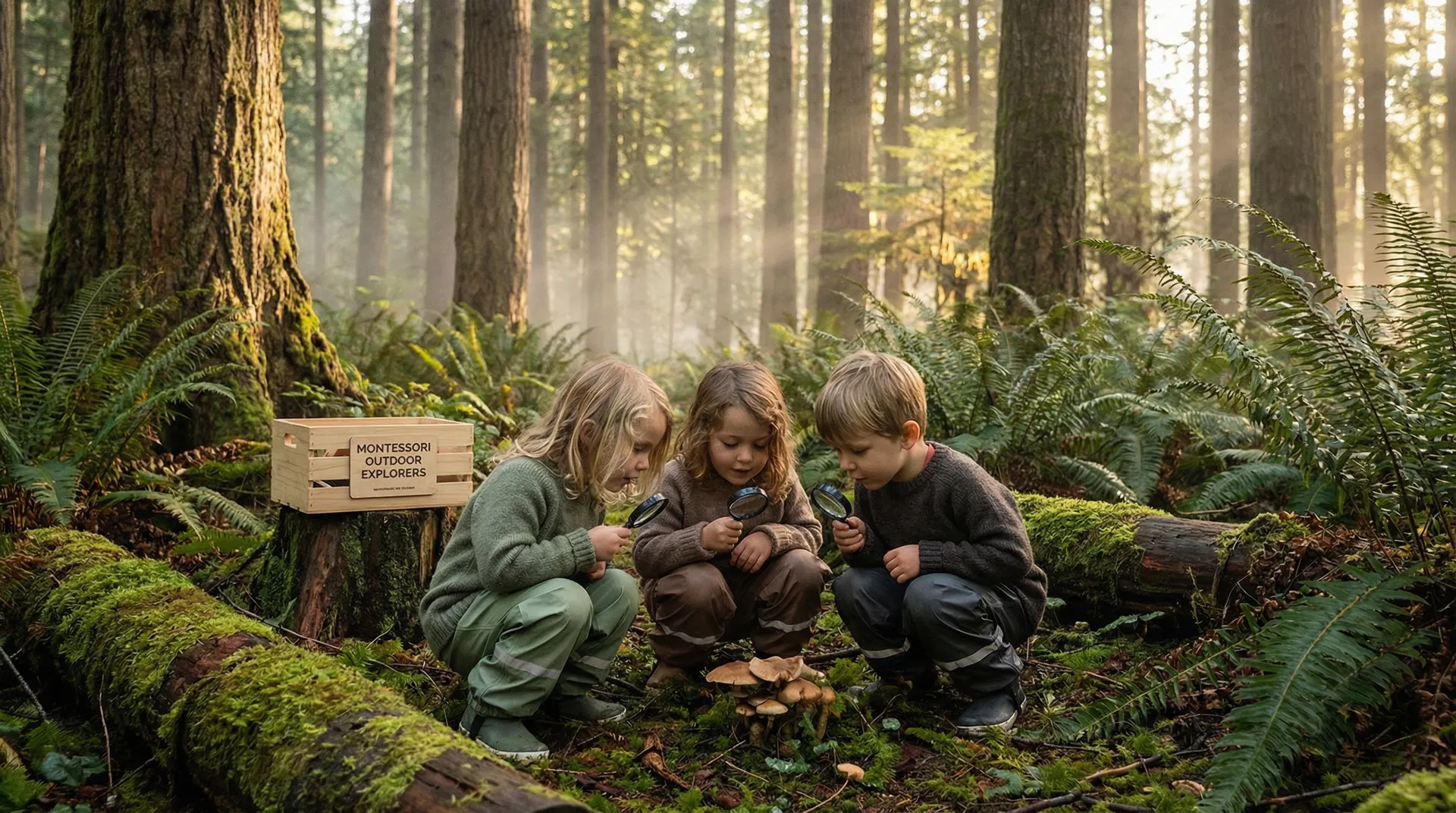
One of the most powerful things you can do as a parent is to become a careful observer of your child. Watch for their intense interests. If they are fascinated by pouring water, provide a small pitcher and a basin in the tub or sink. If they are captivated by tiny objects, go on a nature walk and collect small treasures in a special box. By recognizing and respecting these sensitive periods, you are not just supporting their learning; you are honoring the natural path of their development.
Understanding sensitive periods allows us to see our children not as empty vessels to be filled with information, but as dynamic beings, guided by an inner blueprint for their own creation. To witness how we honor and protect these precious windows of learning in our prepared environments, we warmly invite you to book a tour of our school and see the Montessori philosophy in action.
See Montessori in Action
The best way to understand authentic Montessori education is to experience it firsthand. Book a tour and visit our prepared environments.
BOOK A TOUR